
INSIDE THE GLOBAL CLOUD KITCHEN BOOM

When lockdowns swept across the world in 2020 as a result of the Covid pandemic, food delivery moved from convenience to necessity. According to multiple industry analyses, global online food delivery orders surged during the pandemic and retained much of that volume even after restaurants reopened. Consumers grew used to app-based ordering, contactless payment and rapid fulfilment. For operators, the question was no longer whether to offer delivery, but how to structure it profitably.
Out of that shift emerged the acceleration of so-called dark kitchens, also known as cloud, ghost or virtual kitchens. These are professional food production facilities designed exclusively for delivery or takeaway, with no dine-in space and often no visible storefront. Orders are placed via apps or proprietary websites and prepared in back-of-house environments optimised for efficiency rather than ambience.
The rapid expansion phase, however, was not without friction. In some markets, concerns surfaced around brand transparency, with multiple virtual concepts operating from a single address, as well as questions about local impact and regulatory oversight. The model was at times perceived as opaque and overly driven by platform algorithms rather than culinary identity.
As the sector matured, that perception began to stabilise and now they are booming. Stronger regulatory frameworks, clearer labelling practices and the entry of established restaurant groups shifted the narrative. Rather than being seen as a temporary workaround or disruptive anomaly, dark kitchens are increasingly integrated into hybrid food ecosystems. They now function alongside dine-in restaurants, retail channels and packaged goods strategies, serving as scalable infrastructure for testing, expansion and data-driven product development.
Alongside them, white-label platforms developed. In simple terms, a white-label platform allows a brand to sell under its own name while outsourcing key elements such as online ordering technology, payment systems or last-mile logistics. Together, dark kitchens and white-label tools have become a testing ground for product development and a flexible distribution channel.
A market that grew out of crisis
What began as a stopgap is now a sizeable global market. According to data published by Global Growth Insights, the global dark kitchen market was valued at more than USD 56 billion in 2023 and is projected to expand at a compound annual growth rate of around 11 to 12 per cent through the end of the decade. By 2032, the market is forecast to exceed USD 110 billion. North America currently represents the largest regional share, while Asia Pacific is expected to record some of the fastest growth rates.
The same research notes that delivery-only formats have benefited from lower capital expenditure compared with traditional restaurants. Without front-of-house staff, large dining areas or prime high street rents, operators can enter new neighbourhoods more quickly. For established brands, that equation changes expansion planning. A new postcode can be tested via a dark kitchen before committing to bricks and mortar.
Testing menus and virtual brands
For brands, the most significant shift has been strategic rather than purely operational. Dark kitchens enable rapid menu iteration. A new sauce, plant-based variant or portion size can be introduced digitally, monitored through app analytics and refined within weeks. The feedback loop is immediate. Conversion rates, basket size and repeat ordering provide granular data.
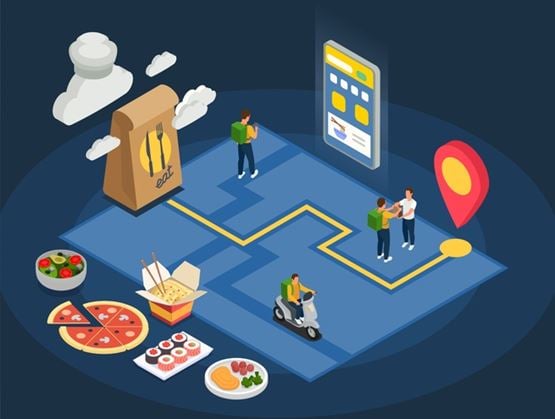
White-label platforms amplify that capability. A restaurant group can launch a virtual sub-brand that exists only on delivery apps. Recipes and production guidelines are standardised, while hosting kitchens prepare the food. Some companies license complete virtual concepts, including brand identity, packaging design and marketing assets, to partner kitchens. The host earns incremental revenue from unused capacity, while the brand owner expands reach without building sites.
Key global markets
This model has been particularly visible in North America, where virtual burger, wing and dessert brands have proliferated across platforms. The United States, which leads the global dark kitchen market in revenue terms, has also seen white-label logistics services allow restaurants to take orders via their own websites while outsourcing delivery fleets. According to Global Growth Insights, the US market alone accounts for a significant proportion of global turnover and is expected to maintain double-digit growth over the coming years.
India stands out not simply as a fast-expanding market, but as one of the most mature cloud kitchen ecosystems globally. Long before the pandemic accelerated delivery worldwide, Indian operators had already embraced the multi-brand kitchen model as a core strategy rather than a contingency plan. Companies such as Rebel Foods built extensive networks producing several cuisines from single facilities, operating across dozens of cities and managing multiple digital-first brands simultaneously.
Regionally, Asia Pacific represents a significant portion of the global dark kitchen landscape, accounting for about 24 per cent of total market share, led by fast-growing markets such as India, China and parts of Southeast Asia. This share reflects both rapid adoption of digital ordering and strong demographic tailwinds, with smartphone penetration rising across urban centres. Asia Pacific’s contribution is expected to grow alongside broader market expansion, with forecasts pointing to continued double-digit growth in coming years.
Dark kitchens in Asia Pacific are supported by rising urban population growth, increasing disposable incomes, and an expanding middle class that favours digital convenience. Around 56 per cent of new food delivery ventures in the region are choosing delivery-only formats as a way to reduce fixed costs and scale more rapidly across cities.
What distinguishes India is not only growth but operational sophistication. Multi-brand portfolios allow operators to target different consumer segments, price tiers and cuisines from the same infrastructure. A single kitchen may host a premium biryani brand, a value burger concept and a healthy bowl offering, each positioned distinctly on delivery platforms. This portfolio approach maximises asset utilisation and reduces risk, as performance data can quickly signal which concept should scale or be retired.
India’s high smartphone penetration, young consumer base and entrenched third-party delivery platforms have created a data-rich environment. Menu changes, limited-time products and entirely new virtual brands can be tested rapidly across multiple cities. In this sense, India functions as a large-scale laboratory for digital-first food distribution. Rather than viewing dark kitchens as secondary to physical restaurants, many Indian operators treat them as primary infrastructure, with dine-in becoming an extension rather than the foundation of brand presence.
In China, the cloud kitchen model has become deeply embedded within the wider on-demand delivery ecosystem, shaped by huge urban populations and dominant app-centric platforms. Analyst estimates indicate that China’s dark kitchens formed a market valued at approximately USD 6.75 billion in 2025, and are forecast to grow to around USD 34.24 billion by 2032, reflecting a compound annual growth rate of roughly 26 per cent over that period. This projected pace is among the highest globally and underscores how quickly delivery-first food formats have been embraced across the country.
Platforms such as Meituan and Ele.me are central to this dynamic, integrating ordering, payment and fulfilment with cloud kitchen partners in a way that blends logistics and data more tightly than in many Western markets. Dense urban clusters such as Shanghai, Beijing and Guangzhou have seen delivery-only kitchens sited close to residential neighbourhoods to minimise courier travel time and optimise fulfilment. These kitchen clusters often operate multiple virtual brands under one roof, mirroring the multi-brand portfolios seen in India but scaled to China’s population and digital infrastructure.
SIAL Canada: A hub for cloud kitchen opportunities
The 2026 edition of SIAL Canada, taking place in Montréal from 29 April to 1 May at the Palais des congrès de Montréal, provides a timely platform for foodservice and retail professionals, including those exploring dark and cloud kitchen concepts. As North America’s largest food innovation trade show, SIAL Canada brings together producers, processors, retailers, buyers and service providers from across the continent and beyond to explore trends, exchange ideas and forge partnerships.
Within the SIAL Grocerant business sector, one of the event’s core pillars, exhibitors will showcase a wide range of equipment, technologies and textiles tailored to foodservice, grocerant and hospitality environments. This makes the show an especially valuable opportunity for businesses considering or already investing in delivery-first formats such as dark kitchens.
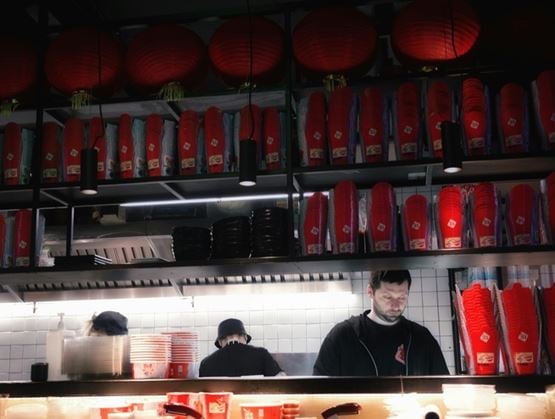
Complementing this, the SIAL Packaging sector highlights innovations in sustainable materials, smart packaging and functional design, all of which are critical to delivery-based models where preservation, transport efficiency and brand visibility play a central role.
Whether the goal is to source specialised equipment, evaluate digital ordering integrations or explore textile and packaging solutions for back-of-house and last-mile operations, SIAL Canada also offers the opportunity to explore the latest food innovations shaping menus and consumer demand. For operators building or refining delivery-first strategies, it provides both the technological infrastructure and the product inspiration needed to develop competitive, future-ready concepts.
From operational tool to product laboratory
The evolution of dark kitchens is now moving beyond restaurant brands. Consumer packaged goods companies are watching closely. A manufacturer supplying sauces or ready meals can partner with a delivery-only concept to showcase applications in a live environment. A beverage producer might test limited-edition flavours via bundled meal offers. While not a substitute for retail distribution, these channels offer real-time consumer insight.
For the wider food industry trade show community, this raises new questions. Distribution is no longer confined to supermarkets and hospitality. At SIAL Network events, conversations around digitalisation, alternative formats and resilience across the food industry sectors are showing this shift. Dark kitchens are not merely a pandemic artefact. They represent an infrastructural layer that has embedded itself in the contemporary food economy. Distribution has become fluid, data-driven and decentralised. For brands willing to experiment, the kitchen without a dining room may be one of the most revealing rooms in the business.
Image credits:
Norma Mortenson - Pexels
Andrew Lvov - Unsplash
Macrovector Official - Freepik