
REINVENTING FOOD: TECHNOLOGY IN ACTION IN 2025

Food has always been a blend of craft and machinery. What is changing in 2025 is the degree of intelligence embedded in that machinery. Algorithms are now helping decide which ingredients enter a recipe, which robot arm plates a dish and which autonomous vehicle brings it to the door. Behind the hype, a sizeable market is taking shape. One global report estimates that the value of artificial intelligence in FoodTech will jump from $6.38 billion (€5.48 billion) in 2024 to $8.58 billion (€7.38 billion) in 2025, with a compound annual growth rate above 30 percent to the end of the decade.
Robots step onto the factory floor
The most mature part of this transformation is taking place on the factory line. In food manufacturing, AI is being woven into inspection systems, process control and predictive maintenance. A recent analysis suggests that the AI in food manufacturing market will expand from $9.51 billion (€8.18 billion) in 2025 to more than $90 billion (€77.4 billion) by 2034.
One striking example is Chef Robotics, a San Francisco based company building spatially intelligent robots for food processing plants. Its machines are designed to work alongside human staff, portioning and assembling ready meals while computer vision systems recognise ingredients and adapt movements in real time. In 2025 the start-up raised $20.6 million (€17.7 million) in Series A funding and says its robots have handled nearly 2,000 ingredients and produced tens of millions of servings in North American facilities.
Further along the value chain, software rather than hardware is doing the heavy lifting. Portuguese start-up BRAINR has secured €11 million in seed funding to digitise food manufacturing plants. Its cloud platform manages around a quarter of Portugal’s meat production, connecting machines, sensors and enterprise systems to cut waste and improve traceability. For many producers, this orchestration layer is the real entry point to AI, since it turns scattered data streams into something algorithms can learn from.
Smart kitchens and robotic restaurants
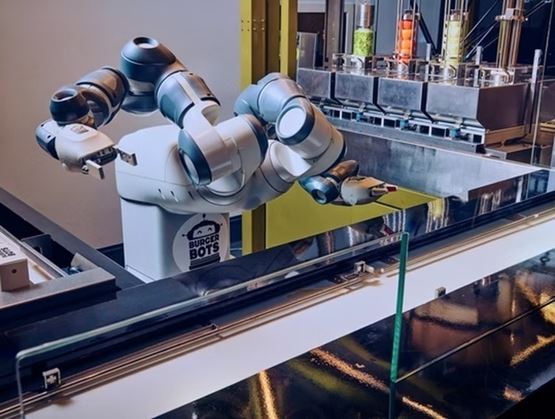
If factories are the quiet heart of FoodTech, robotic kitchens are its showpiece. In Los Gatos, California, BurgerBots and ABB Robotics have created an automated burger restaurant where two industrial robots, including ABB’s IRB 360 FlexPicker and YuMi collaborative arm, assemble made-to-order burgers. One robot selects toppings based on QR code data, the other finishes the sandwich, while the system monitors inventory and cooking times.
The same logic is unfolding in less visible ways inside quick service chains and delivery-only kitchens. Robotics suppliers argue that automated fryers, grill stations and dishwashers can reduce operational costs, limit food waste and improve hygiene by reducing human contact with ingredients. Combined with AI powered ordering systems and dynamic pricing tools, the restaurant of the near future may feel far closer to a software-driven operation than a traditional hospitality venue.
From greenhouse to last mile
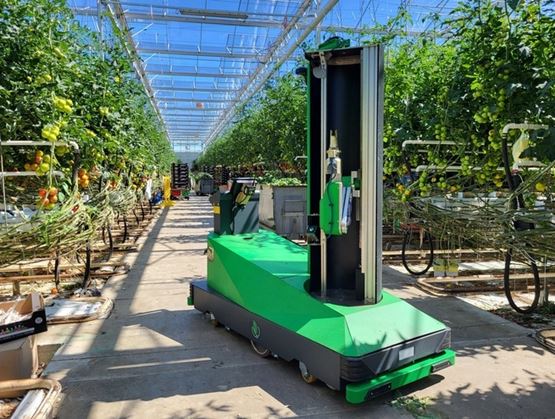
FoodTech’s robotic story starts well before the factory gate. In Brittany and other greenhouse hubs, French start-up AISPRID is deploying an autonomous tomato deleafing robot. The machine moves along greenhouse rows, uses cameras and AI to identify stems and leaves, then performs delicate deleafing work that is both repetitive and physically demanding for human workers. AISPRID closed a €10 million Series A round in early 2025 to accelerate deployment. The pitch is straightforward: higher precision, lower labour dependency and improved plant health.
Technologies reshaping the factory floor are also changing the way food is grown. Farms are beginning to adopt digital tools that monitor soil conditions, optimise inputs and anticipate disease pressure. High-resolution imagery, sensor networks and AI-driven analysis are enabling farmers to produce more efficiently while reducing environmental impact. These systems have taken hold first in higher-value crops, but investors increasingly see potential for scalable platforms that could serve both industrial and smaller agricultural operations.
Innovation is equally rapid inside the processing plant. Advances in biotechnology are making it possible to create ingredients traditionally derived from animals through microbial fermentation, while cultivated meat firms work on producing real muscle and fat cells outside of livestock. At the same time, packaging technologies are becoming more intelligent, providing real-time information about freshness and handling, and blockchain-based systems are strengthening traceability. Automation and robotics continue to tighten operations, bringing efficiency gains and helping manufacturers cope with persistent labour shortages.
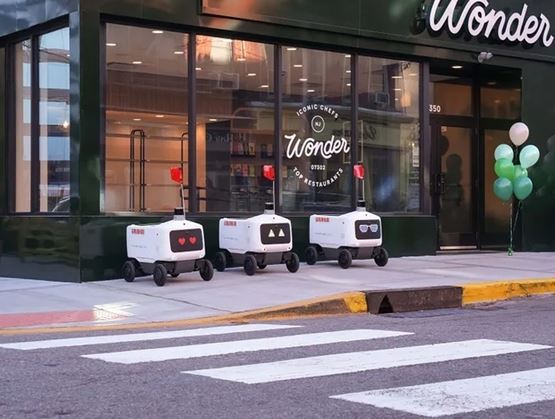
On the delivery side, robots are taking over the last mile in select markets. In the United States, food delivery platform Grubhub and self-driving start-up Avride launched a pilot in Jersey City this year using autonomous delivery vehicles instead of human couriers. The project mirrors similar experiments by other delivery platforms and reinforces the idea that the urban food journey can be treated as a logistics task suited to autonomy and routing algorithms.
Alongside hardware, data driven platforms are attacking food waste itself. Indian start-up Wastelink, for example, has raised $3 million (€2.58 million) to scale a model that turns surplus or rejected food into animal-feed ingredients. While relatively low tech, this kind of upcycling fits squarely into the broader food sector because it depends on Wastink’s software platform to match waste streams with processors and buyers.
As the global population grows and climate pressures intensify, food systems are being forced into a period of reinvention. Demand for food is expected to rise sharply over the coming decades, yet traditional agricultural models are already strained by resource limits and environmental constraints. This is the backdrop against which FoodTech has accelerated: not simply as a wave of innovation, but as a practical response to long-term pressures on production, sustainability and resilience.
Data, jobs and the European lens
Europe’s funding landscape reflects this shift. After several volatile years, FoodTech investment on the continent has steadied, reaching around €4.1 billion in 2024. Although activity sits below the high point of 2021, Europe’s relative stability has increased its weight in the global market. Several large delivery-sector deals in Northern Europe, along with growing investor appetite for aquaculture and next-generation proteins in the Nordics, have helped the region hold its ground even as worldwide FoodTech funding continues to contract.
Behind the eye-catching robots sits a more structural shift. AI in FoodTech depends primarily on data infrastructure. Analysts estimate that the wider AI food market could grow from $9.68 billion (€8.33 billion) in 2024 to nearly $49 billion (€42.14 billion) by 2029. European producers are part of this race, but they operate within stricter regulatory and cultural frameworks.
Automation is set to reshape job profiles in processing plants and quick service outlets. Studies from organisations such as the World Economic Forum note that lower-skilled roles in catering and retail are particularly exposed to AI and robotics. New roles, however, are emerging around maintenance, data analysis and system supervision. Whether the overall effect feels like opportunity or displacement will depend on how quickly training systems and labour policy adapt.
The SIAL Network plays a central role in this story. As one of the world’s leading food innovation exhibition platforms, besides food, it brings together every discipline of the food processing industry, from packaging, filling and packing lines to processing machinery, transport, logistics and storage. Many of the technologies reshaping the industry today first gained visibility at SIAL exhibitions, where global innovators, start-ups and established leaders converge to explore the future of how food is produced, processed and consumed.