
THE NEXT CHAPTER IN PROTEIN INNOVATION

The first plant-based wave changed supermarket architecture, investment priorities and consumer expectations. It also exposed the difficulty of turning curiosity into repeat purchasing. In the United States, plant-based retail sales reached $7.9 billion in 2025, but dollar sales fell 2% year on year. Even so, 60% of US households bought plant-based foods, while plant-based milk alone generated $2.7 billion and represented 13% of total milk dollar sales, according to GFI’s latest US retail analysis.
Those figures make the idea of an “after plant-based” moment more complicated. Plant-based food has not disappeared. It has become an established part of the protein landscape, while its weaker segments are being forced to compete harder on taste, price, nutrition and convenience. The next phase is therefore being shaped by technologies that can solve some of those gaps rather than simply replacing one ingredient base with another.
Fermentation moves from niche process to protein platform
Fermentation is one of the clearest beneficiaries of that shift. The category now spans biomass fermentation, where microorganisms themselves become a food or protein ingredient, and precision fermentation, where microbes are used to produce specific proteins, fats or other molecules. This opens possibilities ranging from mycoprotein and fungal biomass to whey proteins, casein and egg proteins made without conventional livestock production.
The commercial environment remains demanding. GFI’s 2026 State of the Industry report on fermentation counted more than 163 specialised fermentation companies active in 2025, while companies primarily operating in the fermentation ecosystem raised $357 million that year, down from $632 million in 2024. The fall in funding has increased pressure on scale-up economics, offtake agreements and manufacturing efficiency, but it has not stopped technical progress or new launches.
That combination of tighter capital and greater technical maturity may ultimately favour technologies that can fit into existing food manufacturing. Precision fermentation is particularly significant because it can target functionality as well as protein content. A protein that foams, gels, emulsifies or stretches correctly can address formulation problems that have limited some earlier alternatives.
Hybrid products redraw the middle ground
The most commercially important shift may be less ideological and more practical. Hybrid products mix protein sources rather than requiring a complete switch from one system to another. A meat product can combine animal protein with pulses, fungi or plant ingredients. A dairy-style product can combine plant fats and carbohydrates with fermentation-derived proteins. Future formulations may use several alternative proteins at once.
That approach reflects the behaviour of flexitarian shoppers. In 2025, 96% of US households that bought plant-based meat and seafood also bought animal-based meat, according to GFI’s household purchasing data. Hybridisation therefore speaks to a large group already moving between categories rather than abandoning one for another.
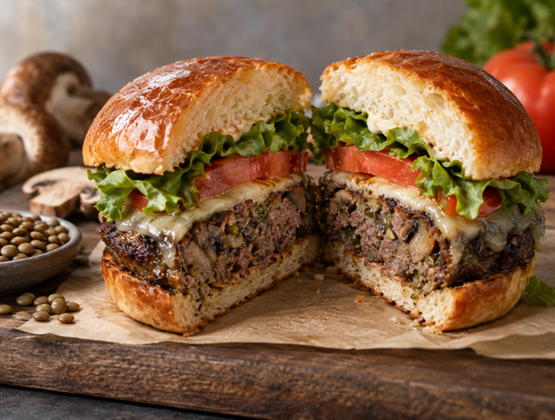
Scientific work on hybrid burgers has shown that partial replacement of meat with plant ingredients, often in the 20% to 50% range, can reduce meat content while retaining familiar sensory characteristics, although acceptance depends heavily on formulation, price and taste. Recent research on hybrid and plant-based products also points to their potential as a bridge for consumers who want to reduce rather than eliminate animal protein. The opportunity is not limited to burgers. Sausages, prepared meals, dairy products and foodservice formats can all become testing grounds for products designed around better balance rather than total substitution.
Protein diversification broadens that logic further. Soy and pea are joined by fava bean, chickpea, fungi, mycoprotein, microalgae and proteins recovered from side streams. Recent food-science research on next-generation proteins increasingly treats these sources as a portfolio, each with different strengths in nutrition, functionality, cost and scalability. For the food innovation show circuit, that creates more room for ingredient combinations and fewer reasons to expect one dominant replacement protein.
Dairy alternatives enter a functionality race
Dairy may be where the second generation of alternatives becomes most visible. Plant-based milk has already reached significant penetration, but cheese, high-protein beverages and other dairy formats remain difficult to reproduce because casein and whey have highly specific functional properties.
Precision fermentation is shifting that equation. Dutch company Vivici secured €32.5 million in Series A funding in February 2025 after demonstrating its beta-lactoglobulin technology at 75,000-litre scale, according to Bio Base Europe Pilot Plant. Later in 2025, Remilk and Gad Dairies launched The New Milk in Israel, using fermentation-derived milk proteins and beginning with foodservice before expanding into retail. These developments illustrate how the category is moving from technology demonstrations towards consumer-facing products.
Europe remains a major research base, although commercialisation depends on regulation and industrial scale. European funders invested €236 million in alternative-protein research in 2025, while fermentation accounted for 29% of funding across the 2020 to 2025 period. Overall, European funders committed €1.3 billion to alternative-protein research during those six years, according to GFI Europe’s research ecosystem analysis. Novel-food approval pathways nevertheless mean that some fermentation-derived dairy ingredients being developed in Europe face a longer route to market than products already commercialised elsewhere.

The next market is a portfolio
The next chapter of alternative protein is unlikely to have a single headline ingredient. Plant-based products, fermentation, hybrids, fungi, algae and precision-made dairy proteins are increasingly overlapping, with manufacturers selecting technologies according to the eating experience they need to deliver.
That represents a significant change for the food sector. Innovation is moving away from a binary contest between animal and plant and towards a broader question of how proteins can be combined, produced and formulated more effectively. Across the SIAL Network, which brings together manufacturers, ingredient specialists, retailers and food innovators, the emerging opportunity lies in that convergence. The companies most likely to define the next cycle may not be those backing one protein system, but those capable of building the right one for each product.