
FOOD HALLS: WHERE LOCAL FOOD CULTURE COMES TOGETHER Article description

A food hall is rarely the quietest place in a city. Plates cross shared tables, queues form and dissolve, cooks work within sight of customers and several meals unfold at once. That apparent disorder is part of the attraction. For time-pressed visitors, these spaces offer something a conventional restaurant cannot: an edible cross-section of a destination.
The idea is spreading quickly. Europe now has more than 135 food halls, with their number doubling over the past eight years. The wider travel appetite is moving in the same direction. The World Food Travel Association’s 2026 research gives food and drink an average importance score of 8.2 out of 10 when travellers choose a destination, while 66% say it matters more to their travel today than five years ago.
More than choice under one roof
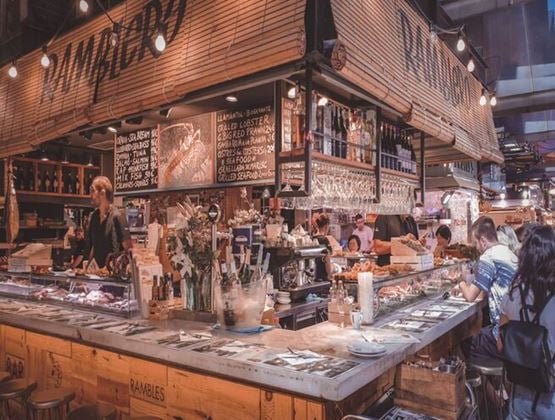
The distinction from the older food court is increasingly important. Food courts are largely designed around convenience, well-known fast-food outlets and quick turnover. Food halls tend to be curated around independent operators, chef-led concepts, speciality retail and a stronger sense of place, often adding events, bars or cultural programming.
That changes consumption. Rather than selecting one restaurant for a complete meal, customers can assemble dinner across several counters. Groups can eat together without ordering the same cuisine, while operators gain visibility from collective footfall. Digital ordering and shared infrastructure are also making complex multi-operator venues easier to manage.
A city eaten in its own rhythm
The strongest halls do not simply gather good food. They reproduce the social grammar of the city around them.
In Madrid, Mercado de San Miguel sits beside Plaza Mayor and receives more than seven million visitors a year. Its counters compress a recognisably Spanish style of eating into a few metres: jamón, seafood, cheeses, rice dishes and small plates designed for grazing rather than a rigid three-course sequence. The experience is built around movement, sharing and trying one more thing.
Copenhagen’s Torvehallerne expresses a different rhythm. Beside Nørreport station, it mixes fresh produce and speciality retail with oysters, smørrebrød, pastries and prepared dishes. Food can be taken home, eaten quickly or lingered over outside, blurring grocery shopping and eating out in a way that reflects everyday urban food culture.
Singapore offers an even deeper version of communal eating. Its more than 110 hawker centres evolved from street-food culture and remain daily “community dining rooms”, where Chinese, Malay, Indian and other culinary traditions meet around shared tables. Their importance comes precisely from being woven into ordinary breakfast, lunch and dinner.
From landmark to local lens
That everyday quality is what modern food halls try to preserve, even when tourism turns them into landmarks. Lisbon’s Time Out Market was created inside the historic Mercado da Ribeira to gather notable local chefs, restaurants and food businesses in one place. By its tenth anniversary in 2024, it had welcomed more than 35 million guests.
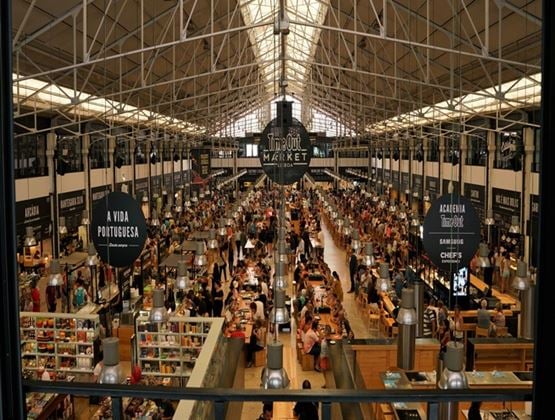
There is a tension here. Popularity can push prices upwards, increase tourist traffic and weaken the sense that a market belongs to residents. Yet the continued growth of the format suggests that travellers are not only looking for local dishes. They are looking for local behaviour: where people stand, whether they share, what counts as lunch and whether shopping and eating occupy the same space.
Giving old spaces a new appetite
Food halls are also changing the physical fabric of cities. Railway buildings, warehouses, power stations and traditional markets lend themselves naturally to the format, allowing large spaces to be divided among smaller operators while preserving some of their original architecture. Helsinki’s Hietalahden Kauppahalli, for example, dates to 1903, while food halls elsewhere have helped bring former industrial spaces back into everyday use.
The model can also lower some of the barriers facing independent food businesses. Shared seating, utilities and other infrastructure allow several operators to trade from the same destination rather than each carrying the full cost of a standalone restaurant. That has become particularly relevant in the UK’s difficult hospitality climate, where food halls have continued to expand. In April 2026, The Guardian reported that 65 new venues were planned across the country, with some chefs using them to test concepts before moving into their own restaurants.
Yet regeneration brings its own balancing act. A food hall succeeds as a destination when redevelopment strengthens the surrounding food culture rather than simply replacing it.
A shop window for the next food idea
For producers, restaurateurs and the wider food industry trade show ecosystem, food halls have become useful laboratories. They reveal which flavours travel well, how consumers respond to unfamiliar dishes and how premium food can move beyond formal restaurant settings into more flexible, social formats.
That same exchange between local identity and international discovery sits at the heart of the SIAL Network. Food halls show what happens when products, culinary ideas and consumer habits meet in a real-world setting. Across SIAL Network events, many of those ideas appear earlier in the journey, as ingredients, concepts and partnerships with the potential to shape how people will eat, shop and discover food in destinations around the world.
Images credits
RichardMC - Pixabay
Algorino - Pixabay
Mihai Vlasceanu - Pexels