
SIAL Canada steps up against food waste

Food waste remains one of the most pressing challenges facing the global food sector, with an estimated one-third of all food produced worldwide lost or wasted each year. This represents approximately 1.3 billion tonnes annually, according to international organisations, highlighting both an environmental and social imbalance that continues to shape industry priorities.
Against this backdrop, trade events are increasingly expected to play an active role in addressing sustainability challenges. Within this context, SIAL Canada is reinforcing its commitment to responsible practices through its SoSIAL programme, placing food waste reduction and community support at the centre of its approach.
A structured response to a global issue
The scale of food waste has far-reaching consequences. Beyond the environmental cost, it directly intersects with food insecurity, affecting millions of people even in developed economies. In Canada, food insecurity remains a significant concern, with food banks experiencing sustained demand.
SIAL Canada’s response is built around a practical and measurable framework. The SoSIAL programme, dedicated to reducing food waste, ensures that surplus food from the exhibition is not discarded but redistributed. At the end of the event, food products from exhibitors are collected, stored and then delivered to local organisations supporting people in need.
This approach reflects a broader shift across food industry sectors, where sustainability is no longer limited to production processes but extends to distribution, events and consumption patterns. Trade shows are becoming active participants in circular practices, demonstrating how large-scale gatherings can minimise waste while maximising social impact.
Tangible impact through partnerships
Central to this initiative is SIAL Canada’s collaboration with Moisson Montréal, the largest food bank in Canada. Since its creation in 1984, the organisation has built an extensive network of nearly 300 community agencies, responding to more than one million requests for food assistance each month.
Through this partnership, food collected during the event is redistributed locally, contributing to a system that already channels nearly 24 million kilograms of food annually to those in need. The efficiency of this model is notable. Each euro equivalent donated generates significantly higher value in redistributed food, amplifying the impact of every contribution.

Tangible impact through partnerships
Central to this initiative is SIAL Canada’s collaboration with Moisson Montréal, the largest food bank in Canada. Since its creation in 1984, the organisation has built an extensive network of nearly 300 community agencies, responding to more than one million requests for food assistance each month.
Through this partnership, food collected during the event is redistributed locally, contributing to a system that already channels nearly 24 million kilograms of food annually to those in need. The efficiency of this model is notable. Each euro equivalent donated generates significantly higher value in redistributed food, amplifying the impact of every contribution.
The results of this collaboration are already visible. During the 2024 edition, nearly 4,500 pounds (over 2,000 kg) of food were collected from exhibitors and donated, demonstrating how coordinated action within a food industry trade show can produce immediate and measurable benefits.
Beyond redistribution, this partnership strengthens links between the food industry and community networks, reinforcing the idea that sustainability is a shared responsibility across the value chain.
Mobilising the entire ecosystem
SIAL Canada’s commitment extends beyond exhibitors. Visitors themselves become part of the initiative. For every registration to the 2026 edition, a donation of five Canadian dollars will be made to Moisson Montréal to support access to quality food for vulnerable populations.
This contribution is further amplified through collaboration with Drive Away Hunger, a national programme led by the agricultural and agri-food industry. Through this initiative, donations are doubled, increasing their reach and impact.
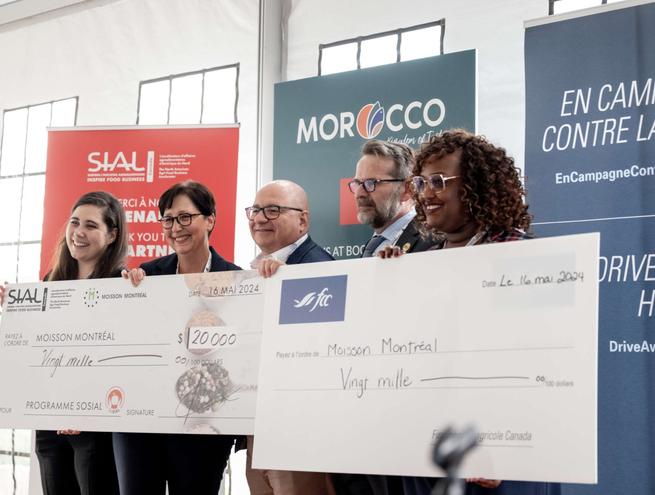
Drive Away Hunger operates across Canada, collecting both food and financial contributions from businesses and redistributing them through food banks and community organisations. In 2024 alone, the programme helped provide more than 514 million meals to Canadians in need, showing the scale at which coordinated industry action can operate.
By integrating this partnership into its event model, SIAL Canada positions itself not only as a platform for innovation but also as an active contributor to food security.
Embedding responsibility into the event model
The SoSIAL programme reflects a broader evolution in how trade events are planned. Beyond showcasing products and trends, they are increasingly expected to align with environmental and social priorities.
For SIAL Canada, this translates into a holistic approach where sustainability is embedded into the event’s structure. Food waste reduction, community engagement and industry collaboration are not treated as separate initiatives but as interconnected elements of a unified strategy.
This approach resonates with wider expectations across the food innovation exhibition landscape. Stakeholders are looking for platforms that not only reflect change but actively contribute to it. By addressing food waste at the operational level, SIAL Canada demonstrates how events can serve as laboratories for responsible practices.
A model for the future of the food industry trade show
As sustainability becomes a defining factor across the global food system, initiatives such as SoSIAL offer a blueprint for future action. They show that reducing food waste does not require complex transformations but can be achieved through coordination, partnerships and a commitment to practical solutions.
Within the broader SIAL Network, SIAL Canada’s approach highlights how regional events can respond to local challenges while contributing to global objectives. By connecting exhibitors, visitors and community organisations, it creates a model where economic activity and social responsibility reinforce each other.
The continued expansion of such initiatives suggests that the role of trade shows is evolving. They are no longer only spaces for business and innovation but also platforms for collective action.
In this context, SIAL Canada’s commitment to reducing food waste reflects a wider transformation within the food sector, where sustainability, solidarity and efficiency are becoming inseparable.