
CHINA’S NEW-STYLE TEA BOOM

Tea in China no longer has to arrive in a pot. It can be shaken with fresh fruit, brewed to order over milk, layered with foam, scented with jasmine or oolong, customised for sweetness and collected from a shop minutes after being ordered through a smartphone.
That flexibility has helped create what is commonly described as the new-style tea category, a broad market built around freshly prepared tea drinks and an increasingly sophisticated interpretation of traditional Chinese tea culture. What began as an alternative to conventional milk tea has become a high-frequency consumer occasion in its own right.
The commercial scale is considerable. China’s new-style tea beverage market reached RMB354.72 billion (€45.6 billion) in 2024, up 6.4%, and was forecast to reach RMB374.93 billion (€48.1 billion) in 2025. Research from iiMedia expects the category to exceed RMB400 billion (€51.4 billion) by 2028.
From occasional treat to everyday purchase
Perhaps the most important change is not what is inside the cup but how frequently that cup is being purchased.
A 2025 iiMedia consumer study found that 69.76% of surveyed new-style tea consumers bought drinks two or three times per week, while a further 18.31% purchased four to six times. Another 22.75% expected their consumption to increase in the future, compared with 12.62% who anticipated buying less.
That frequency has encouraged extraordinary retail density. Industry analysis from Qianzhan estimated that China had around 538,000 operating new-style tea outlets in 2025, up from approximately 527,000 a year earlier.
Scale, however, is becoming less synonymous with easy growth. The market is increasingly crowded, price competition is intense and leading operators are having to extract more value from existing networks.
The diverging fortunes of major chains illustrate that transition. Guming ended 2025 with 13,554 stores, 36.7% more than a year earlier, and by June 2026 had reached 14,351 locations. Its revenue rose 31.9% year on year in the first half of 2026.
CHAGEE, meanwhile, finished 2025 with 7,453 teahouses worldwide, including 7,108 in China and 345 overseas. Its 2025 gross merchandise value increased 7.2% to RMB31.58 billion (€4.1 billion), although average monthly GMV per Chinese teahouse declined from RMB512,000 (€65,750) in 2024 to RMB387,000 (€49,700) in 2025.
The figures capture a category entering a more demanding phase, where new stores alone cannot guarantee momentum.
The cup is becoming simpler and more sophisticated
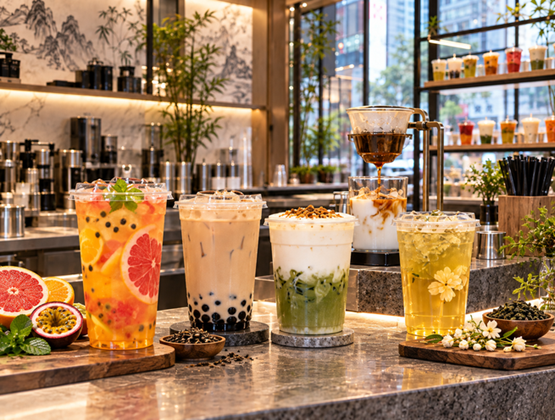
Early new-style tea was often associated with tapioca pearls, elaborate toppings and sweetness. Innovation is now moving in several directions at once.
Tea itself is regaining prominence. Oolong, jasmine, green and other identifiable tea bases are increasingly part of the product proposition, while origin and varietal distinctions are becoming more visible in new product development. Mintel’s 2025 research points to growing segmentation of tea bases by recognised producing regions and varieties.
Health expectations are developing alongside that premiumisation. Research highlighted by SIAL China found that 58.6% of Chinese consumers choosing freshly prepared tea drinks valued their richer taste and texture, while 47.9% cited freshness, 45.4% the ability to customise sweetness and temperature, and 44.8% health and nutritional considerations.

That combination helps explain the emergence of cleaner tea lattes, lower-sugar formulations, fresh-fruit teas and drinks where the flavour of the leaf is deliberately more noticeable.
Technology is also changing the operational side of the category. CHAGEE, for example, uses automated tea-making equipment alongside digital systems covering preparation, supply chains, payments and store management.
New-style tea is therefore developing simultaneously as a beverage trend and a foodservice technology story, opening possibilities for ingredient companies, dairy and plant-based specialists, flavour houses, packaging suppliers and beverage equipment manufacturers.
Where international brands can find room
China is not an empty market waiting for another tea chain. Its largest operators already possess extensive store networks, sophisticated delivery systems, established franchise structures and formidable purchasing power.
Yet consumer loyalty is not absolute. In iiMedia’s 2025 study, 73.09% of consumers said they generally stayed with one or two brands but occasionally tried alternatives. That leaves space for novelty, particularly when it is supported by a distinctive ingredient, provenance, format or experience rather than simply another version of an existing bestseller.
For international businesses, opportunity can therefore extend beyond opening branded stores. Premium dairy ingredients, alternative proteins, natural flavours, fruit preparations, functional ingredients, lower-sugar technologies and automated preparation systems can all intersect with the way the Chinese category is developing.
Fresh fruit illustrates the depth of that supply-chain opportunity. The China Tea Marketing Association has highlighted how Chinese tea companies are increasingly building products around regional agricultural ingredients, requiring cold-chain management and processing solutions capable of taking delicate fruits from local production areas to national menus.
A Chinese category with increasingly global implications
New-style tea has reached a point where the most interesting story is no longer simply rapid store openings. China is building a beverage ecosystem around frequent consumption, fresh preparation, digital ordering, tea provenance, health expectations and industrial-scale supply chains.
That creates a broader opportunity across the food industry trade show landscape. Ingredient manufacturers can observe how traditional raw materials are being reformulated for younger consumers, while beverage businesses can study a retail model that combines the speed of coffee chains with the customisation of modern foodservice.
Across the SIAL Network, these shifts provide a natural meeting point between Asian beverage innovation and companies seeking new formats, ingredients and partnerships internationally.