
DJAZAGRO 2026: AN EDITION THAT CONFIRMS THE MOMENTUM OF THE AGRI-FOOD INDUSTRY

An edition driven by 600 exhibitors from 28 countries
The 2026 edition gathered 600 exhibitors and 700 brands from 28 countries, with strong European representation (44%) and Algerian representation (26%), followed by Asia (21%) and other geographical zones (9%). Topping the rankings by number of exhibitors were Algeria, Italy, China, France and Spain, alongside 23 other nations spread across four continents.
25,000 professionals were welcomed over the four days of the show, including manufacturers, processors, equipment suppliers, distributors, quality managers and buyers. The presence of ambassadors and international delegations also marked this edition, confirming the regional and diplomatic dimension of the event.
Djazagro takes place against an economic backdrop that is undergoing structural change. According to figures from the Ministry of Agriculture and Rural Development relayed by Algeria Invest, the agri-food industry is now the country's second-largest industry after hydrocarbons, with a value estimated at 14 billion dollars. It accounts for 40 to 45% of national industrial added value and employs 40% of the workforce in the manufacturing sector. The Algerian authorities also reaffirmed in May 2025 their ambition to raise non-hydrocarbon exports to 30 billion dollars by 2030.
This national momentum, driven by a clear commitment to economic diversification and food sovereignty, gives the agri-food production show a role as a bridge between the international technology offering and the concrete needs of North African manufacturers.
The Djaz'Innov competition: five innovations recognised
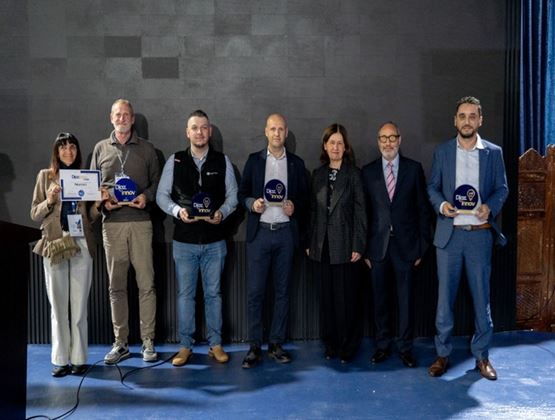
A highlight of the show, Djaz'Innov showcased the most promising advances presented by exhibitors. A jury of independent experts — Amina Chahed (École Nationale Supérieure Vétérinaire d'Alger), Nassima Hamdi (Wanylab), Nazim Bererhi, Béatrice de Reynal (NutriMarketing), Arezki Chenane (Université Mouloud Mammeri de Tizi-Ouzou) and Abdelhalim Boussaa — assessed the innovations against demanding criteria covering their innovative character, relevance and impact.
Twelve products were shortlisted following this evaluation, and five projects were honoured during the Djaz'Innov evening on Sunday 12 April.
The gold medal was awarded to Goglio Spa (Italy) for its Fres-co System+ solution, which directly links packaging lines and flexible laminates via a QR code engraved on the reel, coupled with the MIND IIoT platform. The system enables automatic optimisation of production parameters, reduction of material waste and anticipation of maintenance interventions.
The silver medal went to Acinox (France) for its Hygienic Design Channel, designed to eliminate cross-contamination from floors. This stamped technology, with no welds or retention zones, allows up to 15% fewer product recalls and 94% water savings compared with a standard system.
The bronze medal went to Selected Performance Ingredients (Spain) for its Premium Gummies Formulations range, dedicated to introducing functional ingredients into nutraceutical offerings.
The Jury's Special Mention recognised Climatec Boulanaache (Algeria) for its silent refrigeration unit, entirely manufactured in Birtouta. Suited to urban environments and equipped with low-rotation-speed fans, it significantly reduces noise emissions while operating at medium and low pressure.
A Special Jury Prize was also awarded to Promec srl (Italy) for the Synchrojet Linear Combiblock, a synchronisation system between linear PET preform blow-moulder and rotary filler, suited to a wide range of food and sensitive products.
This list of winners reflects the dominant axes of agri-food innovation in North Africa: digitalisation of production lines, industrial hygiene, functional formulation and adaptation of equipment to local environmental constraints.
The Agora des Experts: the strategic analysis forum
Designed as a venue for reflection and strategic analysis, the Agora des Experts brought together in partnership with Agroligne, the leading agri-food information media outlet at African and international level, and NutriMarketing academics, researchers, entrepreneurs and institutional players. The four-day programme covered the major structural issues facing the sector.
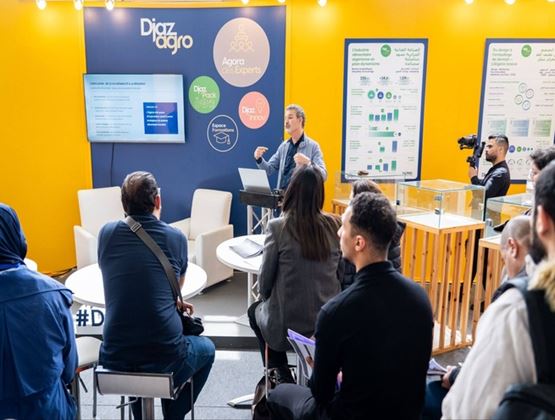
Exports opened the cycle, with a presentation by Toufik Hadkeheil, president of Caflex, on the keys to international success from Algeria toward African, Mediterranean and Gulf markets. Two conferences organised by the Association Nationale des Exportateurs Algériens (ANEXAL) went deeper into the association's role in promoting exports and the opportunities offered by the AfCFTA. Dr Ali Daoudi, agri-economist and lecturer-researcher at ENSA, analysed the structural dependencies and the room for manoeuvre of Algerian food security in the face of geo-economic shifts.
Nutritional quality was another running theme. Kaouther Mokrane (Eat Clean) shared her experience developing functional products tailored to the modern Algerian consumer. Jean-Gabriel Mollard (Comexposium) opened up the discussion on personalised nutrition.
The conferences also addressed digital transformation, with Mouloud Hedid (HM Consulting) on Industry 4.0 and Algerian agri-food performance, CSR as a strategic lever with the experience-sharing of Général Emballage delivered by Ouazna Ouali and Mohamed Bessa, and investment niches in Algerian packaging with Youcef Islem Mimoun (ESSAIA).
The implementation of the HACCP system in the field, presented by Farid Kadi, agri-food expert, drew particularly strong engagement from professionals as it covered regulatory requirements, the financial and logistical constraints faced by manufacturers, and concrete solutions to bridge theory and on-the-ground reality.
The valorisation of plant biomass presented by Dr Samia Dermeche (UMMTO), green innovation in the service of the circular economy with Dr Nabila Hamedi Siad, and training in the food technologies of tomorrow led by Dr Ali Zineddine Boumehira (ENSA) rounded out a programme designed to cross perspectives and project the evolutions of the sector.
A workshop opened the Agora to the sensory dimension, with notably a tasting of Algerian cheeses led by Dr Feriel Adidou.
Djaz'Pack and the Training Space: two initiatives strengthening the agri-food industry
Renewed in partnership with the ALL4PACK EMBALLAGE PARIS show, Djaz'Pack offered a structured educational journey around the major shifts in the packaging world: materials, practical applications and regulatory frameworks. Explanatory panels and showcases of innovative packaging allowed visitors to explore the global packaging market, the challenges and opportunities of the sector in Algeria, sustainable packaging (Reduce, Reuse, Recyclability) as well as a comprehensive overview of the materials used on the Algerian market (paper and cardboard, plastics, glass and metal), with their advantages and limits. With more than 150 exhibitors involved in conditioning and packaging, Djaz'Pack confirmed the growing importance of this strategic link in the agri-food chain.
The Training Space, launched in 2025, brought together six leading academic and scientific institutions: the École Nationale Supérieure Vétérinaire, the École Supérieure des Sciences de l'Aliment et des Industries Agroalimentaires, the Institution de la Nutrition, de l'Alimentation et des Technologies Agro-Alimentaires, the Wanylab Laboratory, the Université des Sciences et de la Technologie Houari Boumediene, and the Laboratoire de recherche Génie des Procédés Industriels. With the support of NutriMarketing, the 2026 edition placed the focus on the maintenance of production tools, identified as an essential catalyst of industrial performance and continuity. These institutions were strongly sought out by visitors, confirming the interest in learning paths and technical careers in the sector.
A show that acts as a facilitator of connections
Beyond the figures, feedback gathered from partners and visitors confirms the strategic function of the event. For Nabil Bey-Boumezrag, Director of Promosalons Algérie, Djazagro is “a bridge between the concrete needs of the North African industry and the companies bringing solutions.” Chantal de Lamotte, the show's Director, points out that Djazagro “has always had this ability to remain perfectly in step with developments in the agri-food sector in Algeria.”
From the players present, testimonials converge. Charbel Chahoud, KFC Director at Azadea, notes that the show can play a key role “by encouraging local suppliers to reach international standards and by raising manufacturers' awareness of the opportunities of this market, particularly for export.” Rami Baccour, Managing Director of Multivac North Africa, recalls that Djazagro is “the only show in Algeria that brings together over 4 days the entire agri-food value chain: from processing to packaging, all the way to the final decision-makers.”
The next edition of Djazagro will take place from Monday 12 to Thursday 15 April 2027 at the Palais des Expositions in Algiers SAFEX.