
FROM WILD BANANAS TO SIAL INNOVATION

A wild banana in Bali does not immediately look like the starting point for an export strategy. For Michael Cantwell, co-founder of Bali Forages, that is precisely the attraction. The fruit is familiar, abundant and naturally sweet, yet the company saw room to rethink the way it reaches the snack aisle.
The result was Banana Crunch, a vacuum-fried snack made from wild bananas and coconut oil, without added sugar or preservatives. Its stripped-back recipe reflects the philosophy behind Bali Forages, whose range also spans beef and chicken snacks, jerky and freeze-dried wholefood products. The company positions its products around natural ingredients, traceable sourcing and nutrient density rather than conventional indulgence-led snacking.
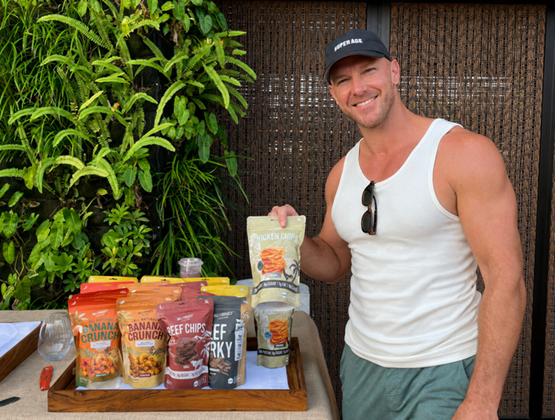
That positioning brought Bali Forages to SIAL Food & Drinks Indonesia, where Banana Crunch received a Bronze SIAL Innovation award. According to Cantwell, the exhibition appealed because it attracted producers, distributors and retailers interested in food quality, sourcing and transparency, while giving the company access to commercial partners looking for alternatives in everyday snacking.
A familiar fruit, treated differently
Banana snacks are hardly new in Indonesia. What Bali Forages has tried to change is the production logic around them. Cantwell says the inspiration came from eating wild bananas in Bali and noticing the contrast between their naturally caramel-like sweetness and many commercial banana snacks that rely on added sugar or other frying oils.
“The goal was to let the banana speak for itself,” he says. The company vacuum-fries the fruit in coconut oil, creating a crisp texture while keeping the ingredient list deliberately short. Its website lists the original product as containing only wild banana and coconut oil, while a cinnamon version adds a spiced variation.
The company’s products sit within a wider shift in Southeast Asian snacking. A 2025 analysis of online snack sales across six Southeast Asian markets found that Indonesia accounted for more than 35% of fruit and vegetable chip sales on Shopee and Lazada during the study period. The report also noted growing interest in products presented around attributes such as natural ingredients and no additives.
USDA reporting on Indonesia points in a similar direction, with healthier lifestyle trends supporting demand for natural snack formats including dried fruit and vegetables, even as established savoury snacks continue to dominate.
Local sourcing becomes part of the product
For Bali Forages, the ingredient story is also a supply story. Michael Cantwell says production begins with local farmers, including smallholder family growers, and that the company favours varieties it considers naturally nutrient dense. He also places emphasis on land stewardship and traceability when describing supplier relationships.
Indonesia’s biodiversity gives that approach a broad palette. Bananas may be the most visible expression of the brand, but cacao, spices, tropical fruit and animal proteins also fit its wider wholefood positioning. Rather than treating origin as decorative storytelling, Bali Forages makes it part of the product proposition.
“We treat snacks as real food, not entertainment,” Cantwell says. Its meat snacks are promoted around protein content and simple seasonings, while its fruit snacks are positioned around minimal ingredients and no added sugar. The common thread is a preference for recognisable raw materials and relatively short formulations.
Cantwell says Banana Crunch development includes chocolate, cinnamon, sriracha and mocha alongside the original format. The company is also preparing export distribution with selected partners in the Middle East, an important step for a brand whose identity remains closely connected to Bali and Indonesian sourcing.
When an award becomes commercial proof
Cantwell says the company’s recognition at SIAL Food & Drinks Indonesia led to increased distributor interest in Indonesia and abroad, as well as new retail discussions in Southeast Asia and the Middle East. By his account, the SIAL Innovation award changed the tone of conversations by adding third-party recognition to a product that buyers may previously have judged mainly on taste.
That is closely aligned with SIAL Innovation, the programme running across the SIAL Network’s international exhibitions. The competition identifies products responding to changing consumer expectations, with evaluation spanning areas including pleasure, health, convenience and environmental considerations. Award-winning products can also gain visibility through SIAL Innovation showcases across other events in the network.
For Bali Forages, that mechanism matters because the company is moving from a strong local narrative towards cross-border distribution. Recognition at a food innovation exhibition can help translate a local product into a format more immediately legible to international buyers.
From Jakarta to a wider network
SIAL Food & Drinks Indonesia provided Bali Forages with the kind of commercial encounter that is difficult to reproduce digitally: buyers can taste a product, inspect the pack, question the ingredients and discuss distribution within minutes. Cantwell says the company intends to return to SIAL Food & Drinks Indonesia because the event has become a place to reconnect with partners and contribute to conversations about food quality in Indonesia.
That local experience sits inside a much larger platform. The SIAL Network brings together 12 leading food and beverage exhibitions, around 700,000 professional visitors and 17,000 exhibitors across 10 food sectors worldwide.
For businesses such as Bali Forages, the value of a food industry trade show is therefore not simply footfall. It is the possibility that one ingredient, one product and one award can move through a network of buyers, markets and conversations. Banana Crunch began with a fruit already embedded in Indonesian food culture. Its next chapter is about seeing how far that familiarity can travel without losing the simplicity that made it distinctive.
Image credits: Bali Forages